🚧
SECTION ON RECONSTRUCTION
Work on this section is in progress. Everything will be available soon.
You run a large company. Somewhere inside it sits a system that cost millions of dollars and does thousands of things. You use three of them, and you still can't tell what's actually going on. We built the fix.
🚧
SECTION ON RECONSTRUCTION
Work on this section is in progress. Everything will be available soon.
A modern Enterprise Resource Planning (ERP) system can run a factory on three continents and calculate payroll in currencies you have never heard of. You use maybe a tenth of it. The yearly licence costs about the annual budget of a small African republic, which you could almost forgive if the thing actually answered questions. It doesn’t.
Need a report? You summon the integrator, who arrives like a plumber and leaves an invoice. Need to know how much cash is genuinely free this week? You convene a committee.
This is the quiet bargain of enterprise software: you buy the cathedral and you use the broom closet. It was built, lovingly, for the accountant and the auditor. It was never built for the person who owns the place.
A standard ERP has two problems, and the first is what it secretly is. Underneath the modules and the dashboards it is an accounting system, and everyone else, sales, production, HR, procurement, is a guest in the accountants' house, made to obey rules that are strict, sacred and rarely explained. You sit down to do your job and can’t shake the feeling that you are still inside the same fifty-tab spreadsheet as before, only wearing a far more expensive interface.
The assumption underneath is quietly insulting: nobody needs to ask what the manager actually wants, because surely a clever person can find his own way through a wall of data.
The second problem belongs to the software companies themselves. Every developer alive knows the first commandment of the trade: never rewrite code that already works, somebody has solved this before, so stand on their solution. Enterprise vendors break that rule on purpose. They keep hundreds of engineers busy rebuilding functions that were finished decades ago. The old ones work fine; quality was never the point. The root of the problem is pretty simple: a proprietary copy keeps you locked in and keeps the vendor paid, so you end up funding a very expensive reinvention of the wheel that stays yours only while the invoices keep clearing.
So we tried to sit on both chairs at once.
The boring, load-bearing machinery really is solved, so we took Odoo, one of the most capable open-source ERP platforms in the world: hundreds of modules already built and tested, from inventory to manufacturing to payroll, documentation in dozens of languages, and tens of thousands of certified integrators on every continent, so you are never tied to a single phone number. Then we asked the question the big vendors never think to ask. Out of this entire zoo, what do you actually need?
Usually the honest answer is “not much of it.” So we switch on only the rooms you actually walk into and leave the rest dark. The engine stays open, inspectable and yours, which is a polite way of saying there is no black box and no vendor quietly holding your data hostage. The ninety percent you were never going to touch simply stops being your problem.
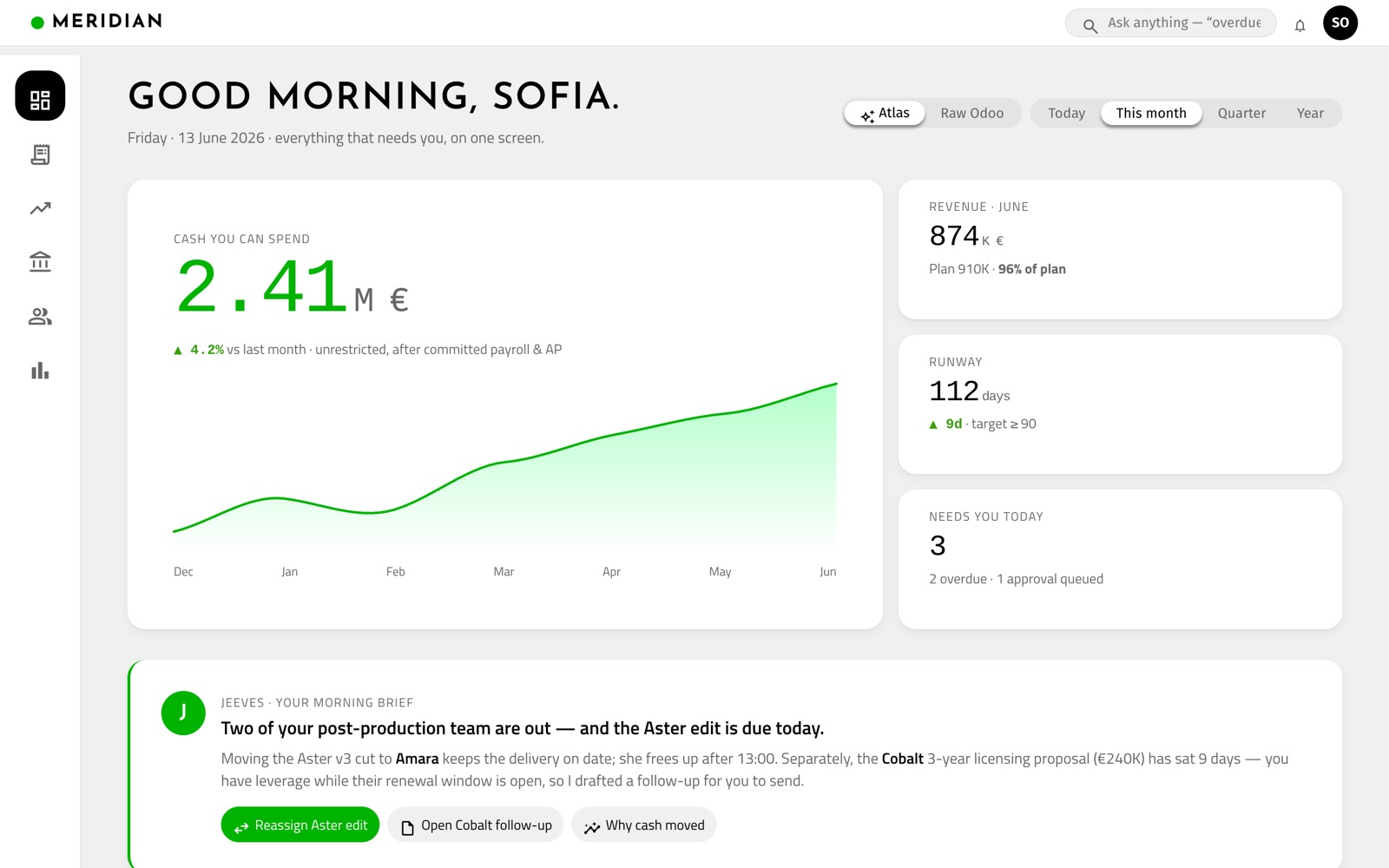
Picking the right modules sorts out what runs underneath. It does nothing about who the thing was built for, which was always the deeper problem: the person who owns the business is almost never the person the ERP was designed for. We spent fifteen years watching owners squint at screens meant for somebody else, and eventually built the missing half ourselves. Atlas answers the three questions an owner actually asks, in plain words and before anything else: where is the money, what is broken, and what needs me? The database can wait its turn.
No more "Unrestricted Cash Balance" in 11px grey. Just the figure, big, in plain words: "cash you can spend." Tabular digits that line up, so 2.4M and 240K never play tricks on you.
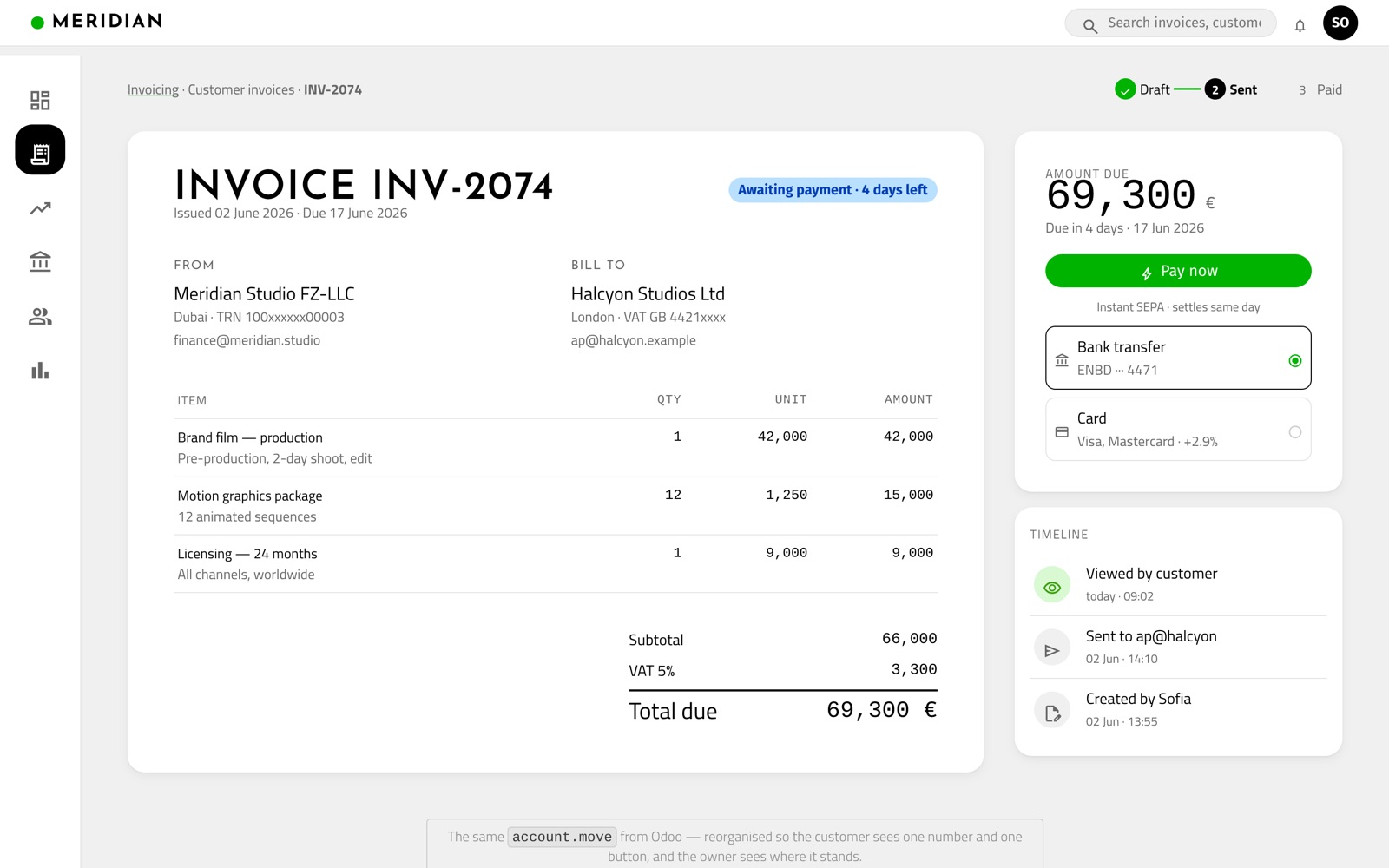
The same account.move Odoo has always had, reorganised so the customer sees one amount and one button, and you see where it stands at a glance, on a status the size of a thought rather than a spreadsheet.
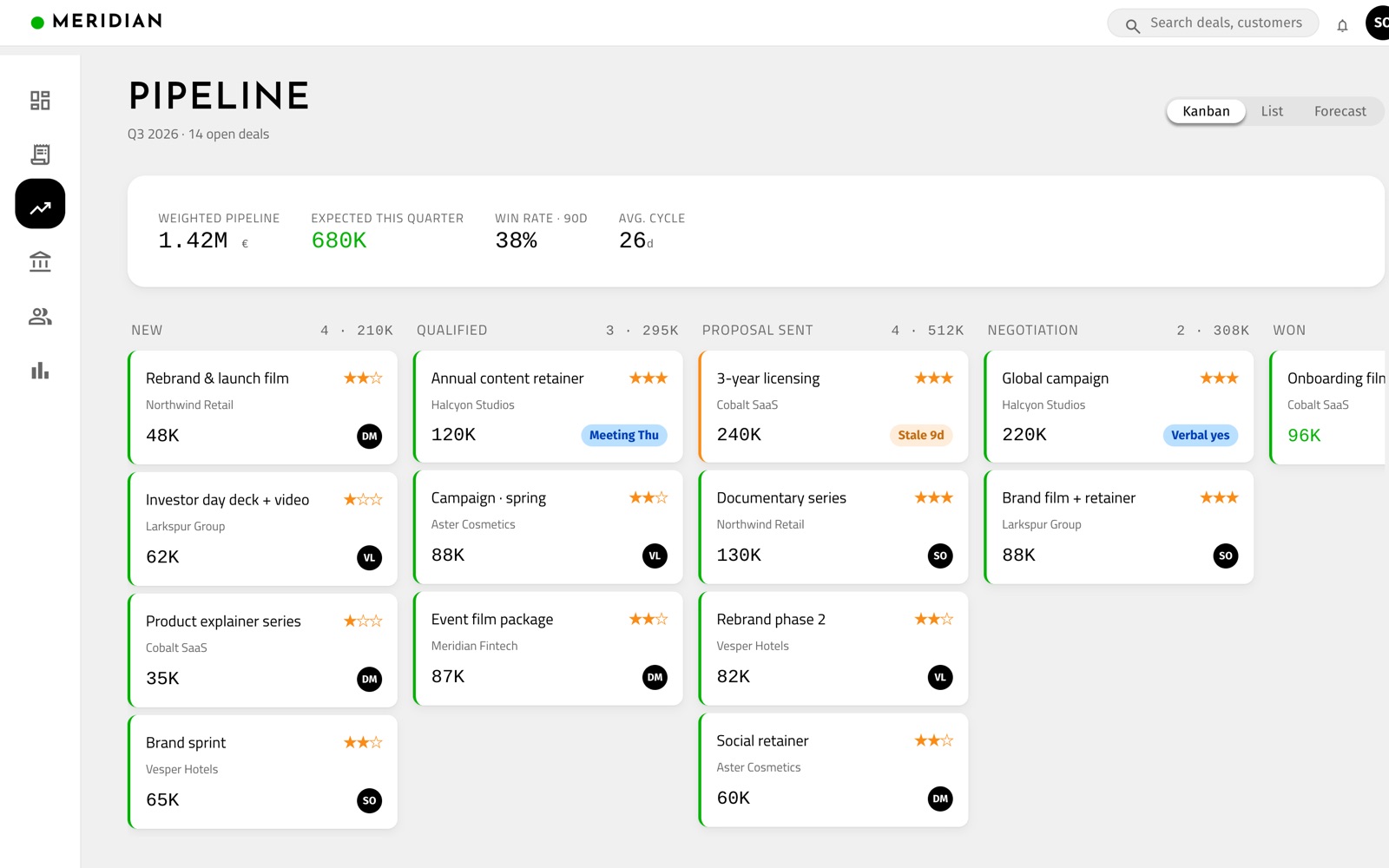
Odoo's CRM kanban, kept, but the deal going stale and the deal about to sign no longer hide inside identical cards. Priority, age and status surface themselves.
If anyone has to suffer for all this, let it be the integrators. Their work used to be indispensable, and billable by the hour. Now their hardest task is explaining what exactly keeps them so busy, because the thing mostly works straight out of the box.
The best thing about Atlas is the one feature the famous vendors can't sell you at any price, because it was never theirs to sell. Call it freedom, or just peace of mind. You know what is going on in your own business without waiting for a colleague to decode a screen for you. You stop bracing for the support contract and for the price list quietly creeping up next January, because the day a vendor annoys you, you can leave and take your data with you. You pay for what you actually use: the bill counts seats, the real people doing real work, while the mythical "core platform" nobody has ever managed to define stays off it entirely. And if even the per-seat price feels steep, hire a developer of your own and point him at the documentation, which covers every button in ten languages. The thing you paid for is, at last, actually yours.
It sounds too good to be true, and we understand the reflex. So don't believe us. Book a demo, bring your CTO, and see the whole thing for yourselves. Or skip the calendar for now and click through the screens as they stand: no login, no sales call, just the dashboard, an invoice and the pipeline, ready to hold up against your own fifty-tab monster.
It's the same Odoo a hundred thousand businesses already run, with the question the owner actually asks put at the top of the screen and a bill that counts only the seats you fill. Once you can picture it on your own systems, the rest is a fifteen-minute conversation.
Want to see what your business is actually doing?
Book a demo today. Schedule your reality check.
Sales 24/7 Hotline:
Phone/WA: +971 52 87-86-777
hi@raredigits.io