🚧
SECTION ON RECONSTRUCTION
Work on this section is in progress. Everything will be available soon.
🚧
SECTION ON RECONSTRUCTION
Work on this section is in progress. Everything will be available soon.
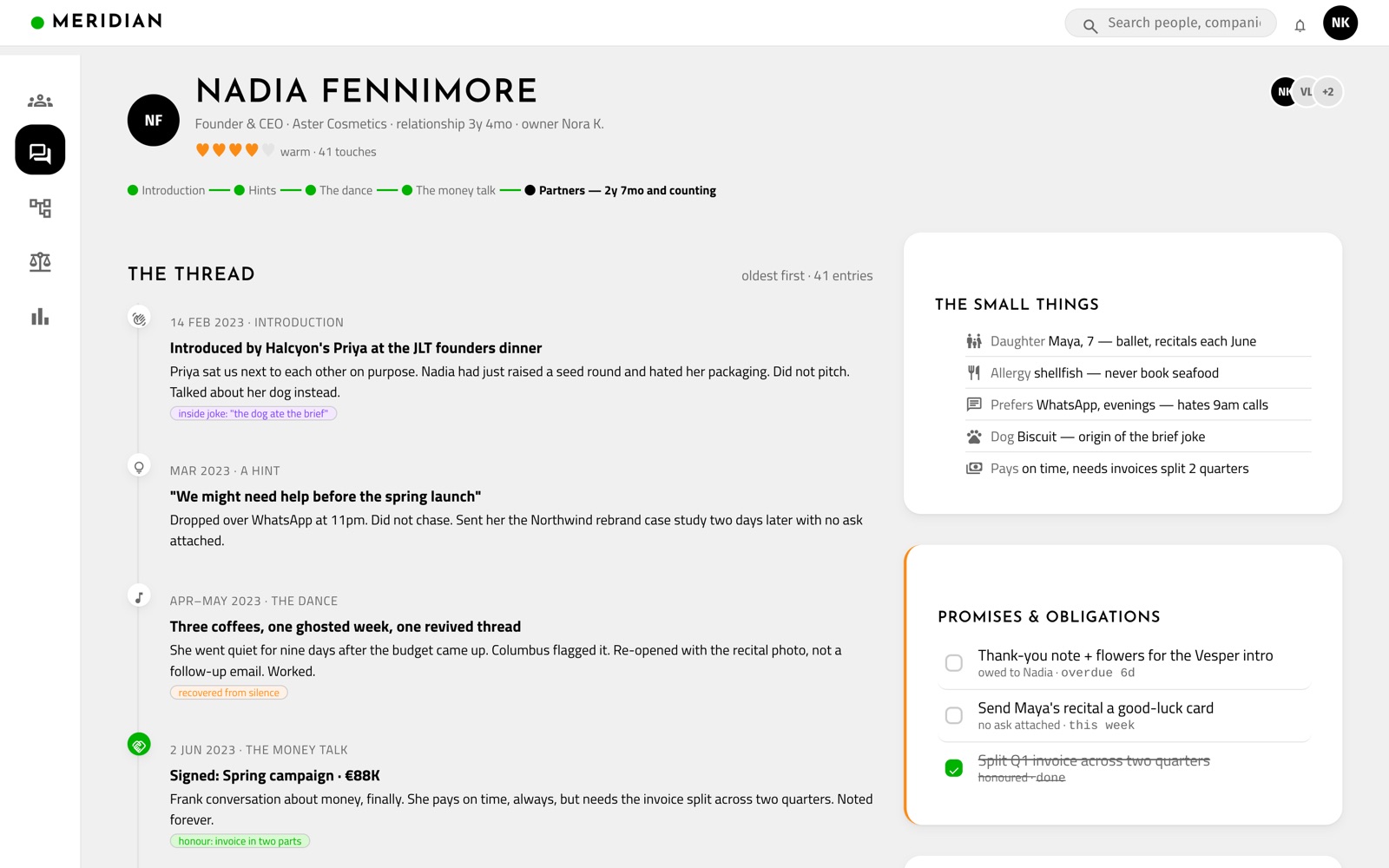
Nobody you have ever sold to moved cleanly through five stages. A real customer relationship is a long thread, the kind that runs for years and never quite closes. It opens with a polite introduction. Then a few hints. Then the slow dance where both sides pretend not to be interested yet. Then, eventually, the frank conversation about money. And here is the part the funnel never mentions: that frank conversation is still only the prelude. The relationship starts after it, and from there it simply keeps going, thick with old in-jokes, callbacks to that dinner in 2021, and a slowly growing pile of favours owed in both directions.
We wrote about the principle on its own, because it is older than any software and worth reading with no product attached: a deal is settled by the unwritten balance between two people, not by the column a card happens to be sitting in. The deal is made between the lines. What follows is what we built once we decided to take that seriously.
A relationship runs on a balance, and a balance needs something to settle it with. A reserve, an exchange fund of things worth trading: an introduction, an idea they can actually use, a decision quietly made in their favour, a problem solved before they noticed it was a problem. The salespeople who never seem to need a pipeline are usually just the ones running a healthy fund, paying in steadily, so that on the day they make a withdrawal the credit is already sitting there.
Columbus runs that fund. It is an ERP for the company’s informal relationships: the discipline your accounting system brings to money, pointed instead at the obligations that never generate an invoice. It keeps the account, lifts the thing that genuinely matters this week to the top, and lets the merely urgent wait, because it knows the difference between a slipped deck and a missed birthday.
Every conversation you have had with a client in one place, found in seconds, so you walk in knowing what you promised in March and what their head of finance is touchy about. The small things that carry a relationship get caught and kept, and when a good client goes quiet, it taps you on the shoulder before the silence becomes a problem.
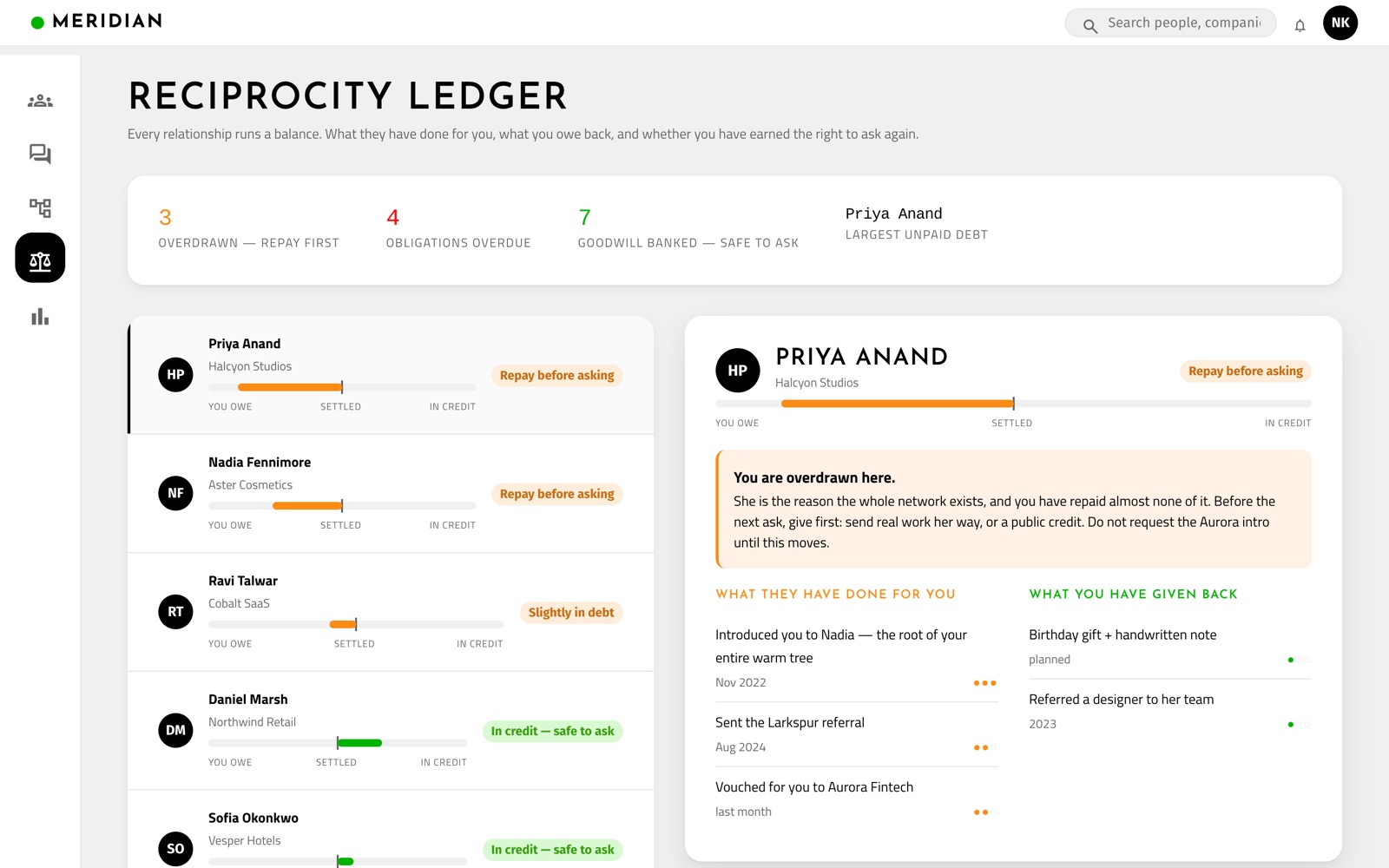
Columbus keeps a running ledger on each relationship, the way a bank keeps one on a borrower: what they have done for you, what you owe back, what is overdue. It tells you, plainly, when you have drawn down more than you have paid in, and holds the next favour until you settle. A relationship you only ever withdraw from eventually closes the account.
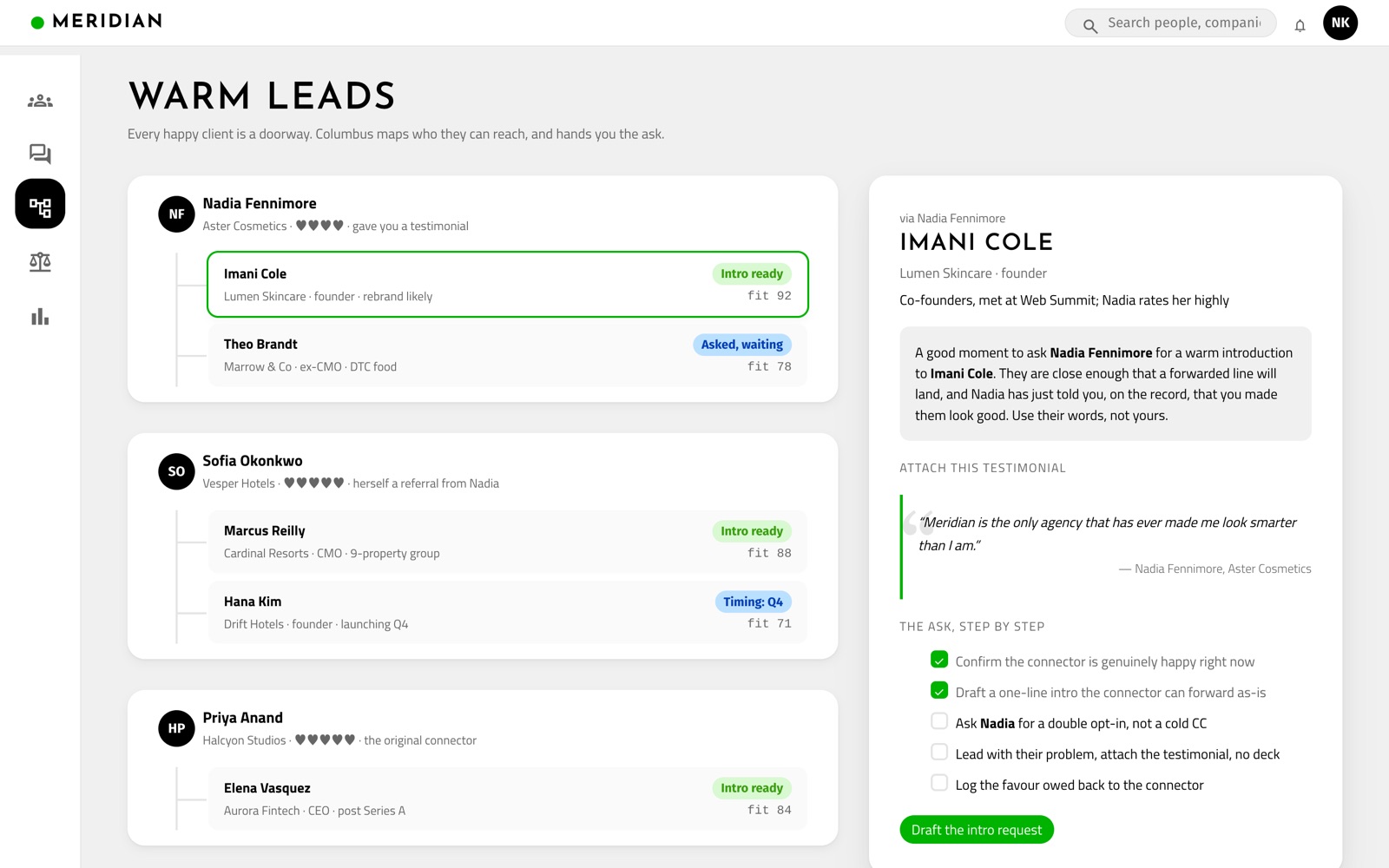
Every happy client stands in the middle of a crowd of people remarkably like them, which is exactly who you want to meet next. Columbus maps who each client can reach, hands you the prompt and the short checklist, and arrives with a real testimonial in their words already attached, because a recommendation opens a door your own pitch never will.
Other relationship tools measure how warm a contact is, which is a sentiment, and then encourage you to spend it. Columbus measures what the relationship is worth in both directions, which is a balance, and now and then advises you to stop.
It is the same account, drawn up properly, with the favours marked to market. The client who sent you eighty thousand euros of referrals and is still waiting on a thank-you note is, in accounting terms, a receivable you have quietly defaulted on. The last email felt warm, certainly. So does a bond the morning before it stops paying. Columbus puts the position in plain figures, names the favour outstanding, and locks the next introduction behind her until the account is current. None of this is about guilt. Guilt is unbacked currency. It is about not running your warmest relationship at a loss while carrying it on the books as an asset.
A relationship kept in credit eventually does the one thing no salesperson can do for himself: it walks into rooms you are not allowed into. The client who owes you nothing, because you have kept the account healthy, turns into your advocate inside his own company. He knows what his budget committee will object to before you do, and he files the rough edges off your proposal on the way in, because by then your deal is quietly his deal too. You did not get past procurement on the strength of your slides. He carried you past it.
That advocate is the most valuable thing a sales team can own, and he is built entirely of goodwill banked over years. Keeping him is what the ledger is really for. Spend the goodwill carelessly, ask one too many times without paying back in, and he goes quiet at exactly the meeting where you needed him to speak.
A cold lead is a stranger you are paying to interrupt, billed to the line item every founder pretends not to read too closely. A warm introduction skips the costly part, because the trust has already been underwritten by someone the buyer believes. Same product, a fraction of the unit cost, which is about the closest thing to free money a sales desk is ever handed. Most of them leave it lying on the table, because asking for the introduction never made it onto anyone’s list, and the exchange fund that would have paid for it was never funded in the first place.
Columbus will not automate the relationship, because that is the one thing in sales you genuinely cannot automate, and you should be wary of anyone who claims otherwise. No script stands in for actually knowing the person across the table.
What it does instead is keep the count, so no part of the story ends up on the floor while you are busy living it: the history, the promises, the running jokes, the favours owed in both directions, the warm doors standing half open all around you. You stay the one having the conversation. Columbus is just the one keeping the books.
The explorer got gold for glass beads, the most lopsided trade anyone remembers, because one side kept track of what was changing hands and the other did not. Every relationship your company has is quietly running some version of that trade, in both directions, all the time. Columbus keeps the books, so that the one handing over the gold while calling it a handful of beads is no longer you.
We built a working demo on a fictional studio’s book of clients. No login, no sales call. Click through the thread, the ledger and the warm-leads tree, and watch a relationship tip from black into red.
Want to see what your business is actually doing?
Book a demo today. Schedule your reality check.
Sales 24/7 Hotline:
Phone/WA: +971 52 87-86-777
hi@raredigits.io